Every adult is an advocate for children: to see and to be heard.
A child is surrounded by a network of adults, caregivers, teachers, healthcare workers, community members, each playing a unique role in their life. But their importance goes beyond the boundaries of a job title, relationship, or setting. Each person in a child’s world is not only a participant, but an advocate.
Being an advocate for a child means seeing the whole child. It means recognising that wellbeing is interconnected, that health, development, learning, and emotional security do not exist in silos. A teacher may notice changes in behaviour. A community worker may spot developmental delays. A caregiver may have a ‘gut feeling’ about something that needs professional attention.
When we begin to see ourselves as part of a broader ecosystem of care, we unlock something powerful: the ability to act early, respond holistically, and support children more effectively. This is why it matters that everyone working with children, irrespective of their context, should possess a basic understanding of different aspects of child wellbeing. Not to replace specialists, but to strengthen the system around the child. Evidence from our network proves that universal screening is not only possible but essential to prevent the R68.6 billion lifetime economic burden of unidentified hearing loss in South Africa. Small observations become early interventions. Collective responsibility drives meaningful impact.
This month, we turned our focus to vision and hearing screening, aligning with World Hearing Day (3 March), which reminds us of the critical role hearing plays in language, learning, and connection. Later in the month, we celebrated World Optometry Week (22 – 28 March), with World Optometry Day on 23 March, which brings attention to vision as a key pillar of development and educational success.
Together, these moments invite us to ask simple but powerful questions:
Are we seeing and hearing our children clearly; and are they able to see and hear the world around them?
By building awareness of sensory health across all those who engage with children, we move closer to a system where no concern is missed, and every child can reach their full potential. By sharing stories from our HMH Network, we can learn from each other and actively reach out, work with each other to scale interventions. To do this, we surface Network Nuggets – pearls of wisdom from our community.
We start with the unexpected, organisations that are not primarily focused on universal hearing or vision screening but have sought opportunities to integrate their existing programmes to include vision and/or hearing screening, such as Siyakwazi.
Siyakwazi is a community-based NPO founded in 2013 that supports children with disabilities and barriers to learning under the age of 7 in rural, under-resourced communities of the Ugu District, KwaZulu-Natal. Their mission is to create inclusive communities where all children aged 0–7 are given equal opportunities to learn by reducing the harmful effects of stigma, exclusion, and lack of essential interventions for children with disabilities and those at risk of falling behind. But the range of disabilities is wide – how does Siyakwazi navigate screening children for hearing and/or vision impairment? This journey began one step at a time, within their existing programmes. A pilot, partnering with a private audiologist.
In 2024, 106 children (age 0-2) in Siyakwazi’s Early Learning programme were screened by a private audiologist resulting in a 51% (n=54) referral rate for specialist intervention. Only 13 of these children were able to access support with 1 child identified with profound hearing loss. This child may have been missed without universal screening. This story mirrors both the solution and challenges with hearing screening.
We must innovate. Not only using technology for easy-to-use equipment but also innovative delivery models that integrate public and private sector as almost 80% of audiologists in SA are based in the private sector. This is championed in the HMH EHDI policy brief.
Additionally, loss to follow up is a shared struggle as pathways are not always clear.
At the time of this initiative, the local clinic was not aware of Siyakwazi’s plans to do the screening, which resulted in challenges when the referrals started flooding through. This led to Mata, who oversees the Early learning programme, creating awareness and building relationships with the sister in charge at the local clinic about what Siyakwazi does and how the hearing screening was an arm of prevention for disability. In doing so, Siyakwazi also developed a clear referral pathway with the clinic from the initial screening by the private audiologist to referred intervention at the clinic. On building this relationship, Mata adds: “Building the relationship and developing a system together was important to guide us on the correct procedure and ensure the child is seen. We can easily discuss concerns and ask questions to get feedback. Strong relationship builds strong trust. She knows the system well and she can connect us to the right services. If we work well together the whole referral process becomes faster, clear, and more effective.”
Although Siyakwazi supports children with disabilities, this approach can be supported by any organisation working with children: they can fill the gap and link programmes. This is taking place in the Eastern Cape with the Small Projects Foundation.
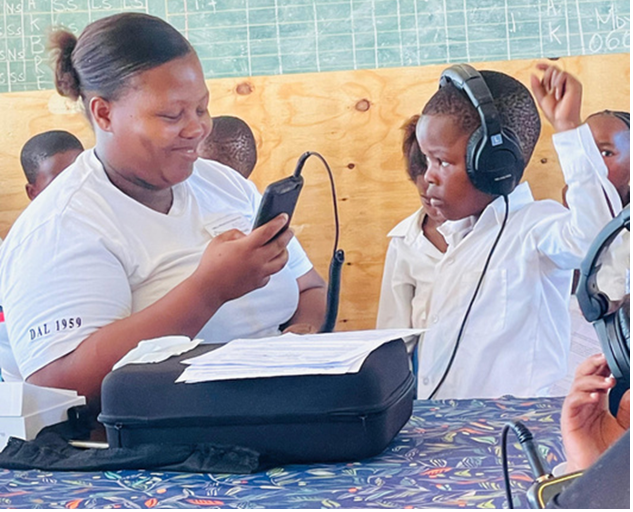
Small Projects Foundation (SPF) has been servicing the Eastern Cape for over 30 years; assisting whenever, and wherever, they are able to. Most of their project's centre around health and/or education, and they confess that often eye and vision health compete with childhood cancer care, and HIV/TB, amongst others. But the goal is to see children as a whole- to not compete but rather to integrate. Today, SPF screens children for both hearing and vision impairment using technology to overcome resource constraints. Because SPF uses mobile phone-based technology instead of charts or complex devices used by audiologists, anyone can screen for vision and hearing impairment!
The SPF model demonstrates how mobile technology can decentralise screening, moving it from tertiary hospitals to the community, which is a core pillar of the EHDI policy brief and the NSAAC's goal to strengthen family-level support.
Lay screeners, often locals in the community, are supported by optometrists via a mobile unit that screens at schools. Over the last two years SPF has screened a total of 47 881 learners and dispensed 4 044 spectacles. Loss to follow up remains a core priority; to extend their support beyond the outreach initiatives, SPF has also developed a toll-free contact number to reduce loss to follow up and ensure all children are not only screened but also linked to care.
These are valuable lessons from remote, smaller organisations making a change. The Hold My Hand partner network also includes experts in vision and hearing screening, who remain open to sharing their knowledge and resources to strengthen early intervention – early means early!
For example, The Carel Du Toit Centre (CDC), a specialised early intervention and education centre in Cape Town, supports children who are deaf or hard of hearing to develop listening and spoken language skills. It provides a holistic package of services including audiology, speech and occupational therapy, early intervention (through the CHAT programme), and family support to enable children’s development. Through early identification, appropriate hearing technology, and language-rich education, the Centre aims to help children transition successfully into mainstream schooling and everyday life. Because of its focus in early identification the Centre also supports Tygerberg Hospital by training screeners to screen all babies before discharge. Otha, child at the CDC's education programme, was not screened through a universal newborn screening programme. His concerned mother suspected an issue, but delays resulted in him only receiving a hearing aid before his second birthday. WHO recommends babies should be screening by 1 month of life, diagnosed at 3 months with intervention no later than 6 months of life. Today he is doing well with a cochlear implant. His mother is now a universal newborn screener at Tygerberg Hospital and an advocate for universal newborn hearing screening. Read her story here.


.png)
.png)


.png)