World Hearing Day: 3 March 2026
Policy brief shows how South Africa can screen every newborn for hearing loss.
In the State of the Nation Address (SONA), the President reaffirmed South Africa’s focus on the crucial first 1 000 days of a child’s life. If we’re serious about that promise, we can’t keep missing one of the simplest, early interventions: universal newborn hearing screening.
A recently released policy brief by Hold My Hand and Change Ideas, in collaboration with an Early Hearing Detection and Intervention (EHDI) Community of Practice, titled: Every child heard: Why South Africa must implement universal newborn hearing screening now, sets out why this matters, why it’s achievable, and what needs to happen next. Each day approximately 17 1 infants are born with permanent hearing loss, that is around 6 0002 each year in South Africa.3
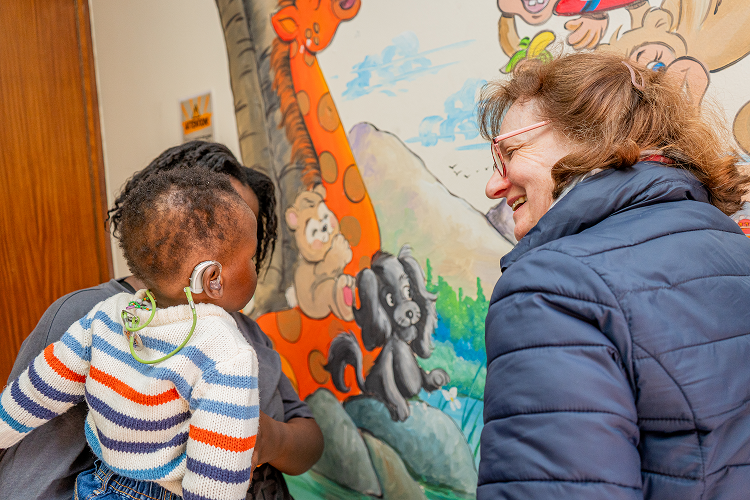
Yet fewer than 10% of newborns receive hearing screening and many children are only identified much later, often at 20-30 months old, long after the window when early detection is essential for healthy child development and overall public health. This is also much later then the World Health Organization’s guideline, which advocates for hearing screening within the first month of life.
Prof De Wet Swanepoel is Professor of Audiology at the University of Pretoria, a WHO Collaborating Centre for the Prevention of Deafness and Hearing Loss, stresses that, “No child should wait years for a condition that can be identified within hours after birth!” adding that “No caregiver should leave a facility without knowing whether their baby’s hearing was checked and what to do next if there is a concern.”
The recently adopted National Strategy to Accelerate Action for Children (NSAAC), recognises this. It lists newborn hearing screening as one of catalytic interventions that can accelerate progress for children. Universal hearing screening is a practical “first 1 000 days win” that can be built into routine maternal and child health services.
Inaction is expensive: the policy brief highlights that the lifetime economic burden of one annual birth cohort of unidentified infant hearing loss is estimated at R68.6 billion (about R1 billion per year of life). The policy brief can be found on the Hold My Hand website: www.holdmyhand.org.za
“Too often, the only children receiving support are those whose families can navigate the system or pay privately,” says Dr Noxolo Gqada, Strategy Lead for the Hold My Hand Accelerator for Children and Teens. “Every child deserves the chance to understand their name, sing a song, or laugh with their friends. We want to give children and families the right to choose, with full information provided, early enough to make a real difference.”
The EHDI Community of Practice, working with Hold My Hand, is calling for South Africa to move from patchy access to a clear national pathway that works for every child:
This year’s theme for World Hearing Day (3 March 2026): From communities to classrooms hearing care for all children, and this year, the Early Hearing Detection and Intervention Community of Practice asks that we rethink the role of the community in relation to hearing impairment. Classrooms are a natural entry point to screen children, however parents, caregivers and the community remain critical to early detection.
Director of HI Hopes and Associate Professor at the Centre for Deaf Studies at Wits University, Prof Claudine Storbeck reminds caregivers to trust their instinct, “the golden rule is, if in doubt follow up, whether it is with your doctor, your paediatrician or healthcare worker. South Africa’s research shows that maternal suspicion is often ignored and would have led to diagnosis of infant hearing loss almost 1 year earlier," Storbeck added.
“World Hearing Day should not only raise awareness,” said Prof Swanepoel, “It should raise the standard. We have local evidence, workable community models and clear lessons on what improves uptake. We need to act on what we already know.”
Hold My Hand: Guided by the draft National Strategy to Accelerate Action for Children (NSAAC) which is led by the Presidency, the Hold My Hand campaign is a growing movement committed to putting children and teens at the heart of change. It calls on parents, caregivers and adults to walk alongside children and teens, to hold their hands, listen to their truths, and act together to build a safer, fairer, stronger South Africa.
Early Hearing Detection and Intervention (EHDI) Community of Practice:
An open, collaborative network bringing together stakeholders from across the care pathway to strengthen early hearing detection and intervention. Shared learning, coordinated action, and continuous improvement is fostered. All who play a role in the EHDI landscape are welcomed and invited to participate, connect, exchange insights, and co-create solutions that advance accessible, equitable EHDI services for all children and families across South Africa.
Issued by Hold My Hand on behalf of the Early Hearing Detection and Intervention Community of Practice
Read the policy brief: Every child heard: Why South Africa must implement universal newborn hearing screening: now available at holdmyhand.org.za
Join our EHDI Community of Practice: LINK
[1] High Hopes Vision. https://www.hihopes.co.za/ accessed 27 May 2024.
[3] Swanepoel, DW, Störbeck, C & Friedland, P. 2009. Early hearing detection and intervention in South Africa. International Journal of Pediatric Otorhinolaryngology. 73(6):783–786. doi.org/10.1016/j.ijporl.2009.01.007.
.png)
.png)


.png)